Business News Today

All News Business and Finance, banks and business companies and the economy you find here every day. Follow us in each new world of finance and business.

NEW YORK - Wall St gains strength, Nasdaq near its 10-year high

الخميس، 28 أبريل 2011

NEW YORK - Wall St gains strength, Nasdaq near its 10-year high


NEW YORK (Reuters) – U.S. stocks edged up on Thursday, erasing early losses as investors brushed off disappointing economic data and bet on a further rally in equities.

The gains came after major indexes hit multi-year highs in the previous session. The enthusiasm in the market had pushed the Nasdaq to a 10-year high, and the Dow is now up 10 percent and the S&P 500 up 8 percent for the year.

Stocks were pressured at the open after a report showed new U.S. claims for unemployment benefits surprisingly rose last week to their highest level since January.

Separate data showed U.S. economic growth slowed more than forecast in the first three months of the year as higher food and gasoline prices dampened consumer spending and sent a broad measure of inflation rising at its fastest pace in 2-1/2 years.

"Investors are willing to look through the GDP data because most of the weakness was beyond the consumer... If you really just look at the organic power of the consumer, for the most part it is remarkable to me that spending is as strong as it is in the face of $4 gasoline prices," said Jack Ablin, chief investment officer at Harris Private Bank in Chicago.

The Dow Jones industrial average (.DJI) was up 38.79 points, or 0.31 percent, at 12,729.75. The Standard & Poor's 500 Index (.SPX) was up 2.33 points, or 0.17 percent, at 1,357.99. The Nasdaq Composite Index (.IXIC) was down 1.44 points, or 0.05 percent, at 2,868.44.

The Nasdaq jumped to a 10-year high on Wednesday as Wall Street rallied on the prospect of continued low interest rates and liquidity until the end of June.

Earnings season has been strong, but there were signs of creeping costs from some companies. Procter & Gamble Co (PG.N) lowered the high end of its profit forecast as it trimmed expenses and increased prices to offset rising materials costs. Its shares fell 0.5 percent to $65.22.

"These consumer products (companies) are bearing most of the brunt from the higher commodity prices, because not only are commodities in general hurting costs, but high energy, in particular gasoline, is crimping demand as their consumers are forced to economize," Ablin said.

Rising costs were also in evidence at Starbucks Corp (SBUX.O) . The company warned on Wednesday that costs will take a bigger chunk out of earnings than previously anticipated, and its full-year forecast disappointed Wall Street. The shares fell 0.5 percent to $36.98.

Other economic data showed pending sales of existing U.S. homes were much stronger than expected in March, offering faint glimmers of hope for the depressed U.S. housing market.

Home builder Pulte Group Inc (PHM.N) reported a smaller-than-expected quarterly loss, and its shares rose 4.2 percent to $8.32.

(Editing by Padraic Cassidy)

LONDON/NEW YORK - Exxon, Shell profits surge on higher oil prices

LONDON/NEW YORK - Exxon, Shell profits surge on higher oil prices


LONDON/NEW YORK (Reuters) – Exxon Mobil Corp and Royal Dutch Shell Plc posted steep jumps in first-quarter profits and beat analysts' forecasts, helped by high oil prices and buoyant refining margins.

Profits for the world's biggest oil producers have surged as oil prices moved above $100 per barrel in the first quarter on unrest in the Middle East and Africa and growing global demand for energy.

Exxon, the world's largest publicly listed company, posted a 69 percent increase in earnings to $10.65 billion, its biggest profit since the third-quarter of 2008, when oil prices last traded above $100 per barrel.

The company was alone among its Western peers to so far record an increase in production in the quarter, notching up a 10 percent increase from a year-earlier to 4.82 million barrels of oil equivalent per day (boepd), helped by its takeover of U.S. natural gas company XTO last year.

Shell's earnings rose 22 percent to $6.9 billion, although asset sales pressured its oil and gas output down 3 percent 3.50 million boepd.

Still, that decline was more modest than the 11 percent drop that BP Plc reported on Wednesday and 7 percent drop in ConocoPhillips's output.

BP has been selling assets to pay the more than $40 billion in liabilities it racked up from the massive oil spill in the Gulf of Mexico last year, while Conoco had been shedding assets to pare its debt load.

GAS BUBBLES UP

Shell, the largest shipper of liquefied natural gas, also benefited from higher LNG prices following the Japanese earthquake, which was expected to lead to higher LNG demand in that country as nuclear power is scaled back.

That LNG strength, plus a number of large projects coming on stream this year, sparked hopes that Shell could join Exxon and Chevron in raising its dividend payments to shareholders.

Exxon raised its second-quarter payout 7 percent on Wednesday, while Chevron, while boosted its dividend 8 percent.

Chevron is due to release its quarterly earnings on Friday.

Fatter profit margins at both Exxon and Shell refineries that process crude oil into products such as gasoline, diesel fuel and jet fuel also helped their quarterly earnings.

Exxon also benefited from a jump in earnings from its chemicals arm, which recorded $1.5 billion in profits in the quarter. The company is the second largest U.S. chemicals maker behind Dow Chemical.

"It looks like chemical was really strong," Phil Weiss, oil analyst at Argus Research, said about Exxon's earnings. "And production came in on the higher side relative to my expectations, especially gas."

Shares in Shell rose 0.7 percent to 2325.5 pence on the London Stock Exchange, while Exxon shares were off 0.5 percent to $87.35 on the New York Stock Exchange.

U.S. oil and gas companies Apache Corp and Occidental Petroleum Corp both reported earnings that topped Wall Street forecasts, lifting their share prices.

(Additional reporting by Marie Maitre in Paris, Anna Driver in Houston and Braden Reddall in San Francisco)

(Reporting by Matt Daily; editing by Gunna Dickson)

NEW YORK - Wall Street near session highs on Fed chief's view

الأربعاء، 27 أبريل 2011

 NEW YORK - Wall Street near session highs on Fed chief's view


NEW YORK (Reuters) – U.S. stocks extended gains on Wednesday, with the S&P and the Nasdaq near session highs after the Federal Reserve signaled it was willing to maintain its extensive support for the U.S. economy and corporate earnings continued to impress.

The Fed's policy-setting Federal Open Market Committee said in a statement it intends to complete its $600 billion bond buying program in June as scheduled.

"The tweaks in the QE2 language strongly suggest they are going to continue not only with QE2 but reinvesting mortgage cash flows," said Max Bublitz, chief investment strategist at SCM Advisors in San Francisco.

"I don't think anybody thinks this is going to be the highlight of the day," Bublitz said of the FOMC's statement. "It is the press conference."

Market gains were limited, however, as investors dissected comments from Fed Chairman Ben Bernanke, who is holding his first-ever press conference.

General Electric led the Dow higher, rising 3.1 percent to $20.73 after the company's finance chief said the company's profit growth over the next few years will be the fastest it had seen in a decade.

Boeing Co (BA.N), Whirlpool Corp (WHR.N) and WellPoint Inc (WLP.N) also moved higher after topping analyst consensus expectations. Boeing, a Dow component, rose 0.8 percent to $76.17.

Whirlpool gained 0.3 percent to $88.14 and WellPoint added nearly 3 percent to $75.12.

According to Thomson Reuters data through Wednesday, of the 220 companies in the S&P 500 that have reported earnings, 73 percent have posted earnings above estimates.

The run of solid earnings has lifted the S&P 500 to levels not seen in nearly three years, with the index breaking through a key resistance level of 1,344 on Tuesday.

The Dow Jones industrial average (.DJI) gained 56.76 points, or 0.45 percent, to 12,652.13. The Standard & Poor's 500 Index (.SPX) gained 2.68 points, or 0.20 percent, to 1,349.92, close to its session high at 1,350.88. The Nasdaq Composite Index (.IXIC) gained 8.08 points, or 0.28 percent, to 2,855.62, just a touch off its session high.

Earlier, the Dow climbed as high intraday as 12,655.31.

(Reporting by Chuck Mikolajczak; Editing by Jan Paschal)

WASHINGTON - Durable goods data shows manufacturing sturdy

WASHINGTON - Durable goods data shows manufacturing sturdy


WASHINGTON (Reuters) – A key gauge of U.S. manufacturing rose in March and new orders in February were stronger than initially thought, indicating a vibrant factory sector even as the economy slowed in the first quarter.

New orders for manufactured goods meant to last at least three years increased 2.5 percent after an upwardly revised 0.7 percent rise in February, the Commerce Department said on Wednesday.

The rise in March durable goods orders beat economists' expectations for a 2 percent advance, while orders in February had been previously reported to have dropped 0.6 percent,

Though the report -- which showed upward revisions to key categories in February -- did not change views that the economy slowed sharply in the first three months of this year, it confirmed that manufacturing continued to power the recovery.

"It's fairly evident that the industrial sector of the U.S. economy is the growth driver and continues to be," said Neil Dutta, an economist at Bank of America Merrill Lynch in New York.

The recovery lost a step in the first three months of the year as harsh winter weather restrained activity and high gasoline and food prices weighed on consumer spending.

Government data on Thursday is expected to show growth slowed to an annualized rate of 2.0 percent or even less in the first quarter, according to a Reuters survey. The economy grew at a sturdy 3.1 percent rate in the fourth quarter.

The slowdown in first-quarter growth was acknowledged by Federal Reserve officials who at the end of a two-day meeting on Wednesday described the recovery as proceeding at a "moderate pace" -- a slight step back from a statement in March when it said the economy was on a firmer footing.

The Fed signaled it was in no rush to scale back the massive support it has given the economy.

Orders for long-lasting manufactured goods last month were buoyed by bookings for motor vehicles, transportation equipment and aircraft.

Excluding transportation, orders rose 1.3 percent after a revised 0.6 percent gain in February, which was previously reported as a 0.3 percent drop. Economists had expected this category to rise 1.8 percent.

The fairly strong manufacturing tone was captured by leading home appliance maker Whirlpool Corp, which reported a rise in first-quarter net profit rose to $169 million from $164 million a year earlier.

Manufacturing has been central to the economy's recovery from the worst recession since the 1930s, even though it constitutes less than 15 percent of economic activity.

A weaker dollar, which hit a three-year low against a basket of currencies on Wednesday, is helping the sector.

The durable goods report showed non-defense capital goods orders excluding aircraft, a closely watched proxy for business spending, rose 3.7 percent last month after an upwardly revised 0.5 percent gain in February.

"Concerns over capital spending triggered by weakness in the first month of the quarter prove unfounded," said Michelle Girard, an economist at RBS in Stamford, Connecticut. "There is no indication that capital spending plans are being substantially curtailed."

Shipments of non-defense capital goods excluding aircraft rose 2.2 percent after advancing 0.4 percent in February. This component goes into the calculation of the government's measure of gross domestic product.

Orders for primary metals rose 3.9 percent in March, while machinery orders jumped 4.2 percent. However, orders for computers and electronic products fell, as did orders for communications equipment.

While it was too early for potential supply disruptions from the devastating earthquake and tsunami in Japan to show in the March report, analysts expect the impact on the U.S. economy to be minimal.

(Editing by Chizu Nomiyama)

NEW YORK - BP, Conoco profits disappoint as output sags

NEW YORK - BP, Conoco profits disappoint as output sags


NEW YORK (Reuters) – BP Plc (BP.L) and ConocoPhillips (COP.N) reported disappointing quarterly profits on Wednesday as the big oil companies' crude oil production fell, offsetting the windfall from soaring energy prices.

BP's profits slipped 2 percent from a year ago as costs related to the Gulf of Mexico oil spill last year continued to take a toll, while Conoco's output suffered from the conflict in Libya and pipeline problems in North America.

Crude oil prices rose nearly 40 percent in the quarter from the previous year, and margins to turn oil into gasoline and diesel have fattened, raising expectations that world's biggest oil companies would see profits skyrocket.

BP shares traded in New York fell less than 1 percent, while Conoco shares were down 2.7 percent.

"Energy stocks in general are off today. The sector has been one of the better-performing groups, so I think people are taking the opportunity to take a few profits," said Mike Breard, oil analyst at Hodges Capital in Dallas.

BP's oil and gas production tumbled 11 percent as it sold assets to pay the billions of dollars in liability it faces for the April 2010 oil spill at its Macondo well.

BP's first-quarter profit fell 2 percent while Conoco's profit rose 44 percent. Results at both companies fell short of analysts' forecasts.

LIBYA HURTS

Conoco and Italy's oil and gas group Eni (ENI.MI) said lost production because of the turmoil in Libya would cut into the year's output.

Houston-based Conoco recorded a 7 percent decline in oil and gas output to 1.7 million barrels oil equivalent (BOE) per day because the of Libya shutdown and the outage of the Trans Alaska Pipeline system in January, as well as its own asset sales.

With no end in sight for the unrest in Libya, Conoco lowered its current production outlook by as much as 50,000 BOE per day. The company could not provide any details about the state of its operations in that country.

"We just don't have communication channels," Chief Financial Officer Jeff Sheets told Reuters.

In Libya, Conoco holds a 16.3 interest in the Waha concessions, where net oil production averaged 46,000 barrels per day last year.

Eni (ENI.MI) said the Libyan turmoil would cut its full-year production after a drop of nearly 9 percent in the first quarter.

Since April, production in Libya has been about 50,000 to 55,000 barrels of oil equivalent per day (boepd), down from the 280,000 boepd expected before the uprising against leader Muammar Gaddafi erupted in February, Eni said.

Eni's adjusted net profit rose nearly 22 percent, topping analysts' forecasts and lifting the company's shares about 1.7 percent.

Shares of U.S.-based oil and gas producer and refiner Hess Corp (HES.N) rose more than 5 percent before pulling back after the company said a key prospect in Ghana had shown significant resources.

Analysts were awaiting news of Hess' drilling program at the Paradise offshore prospect, and the discovery overshadowed a lower-than-expected 73 percent rise in first quarter profits.

"They've gone for a little while without a big discovery," said Stephen Davis, associate portfolio manager with Alpine Mutual Funds. "It's nice to see the exploration program back on track."

Exxon (XOM.N), the world's largest publicly traded oil company, is due to report earnings on Thursday.

(Additional reporting by Stephen Jewkes in Milan, Tom Bergin in London and Anna Driver in Houston. Editing by Derek Caney and Robert MacMillan)

LONDON - FTSE closes higher after break

LONDON - FTSE closes higher after break

LONDON (AFP) – London shares closed higher on Tuesday, extending last week's gains after the Easter break, with technology and banking shares offsetting mining losses.

The benchmark FTSE 100 index rose 0.85 percent to finish at 6,069.36 points -- its highest level in over two months.

Vodafone Group was the most traded stock, seeing 90.6 million shares change hands, followed by Royal Bank of Scotland (RBS) with 56 million.

The biggest blue chip riser was International Consolidated Airlines, which jumped 4.51 percent -- 9.9 pence -- to 229.6, followed by technology company ARM Holdings, which climbed 3.39 percent -- 20.5 pence -- to 625.5.

The biggest faller of the day was gold miner Randgold Resources Ltd, which dropped 2.07 percent --110 pence -- to 5,195, followed by TUI travel, which slumped 1.17 percent -- 2.8 pence -- to 236.1.

At 1710 BST the pound was trading at 1.647 dollars, while the UK currency stood at 1.126 euros.

SINGAPORE - Aussie dollar hits 29-year peak; Seoul shares shine

الاثنين، 25 أبريل 2011

SINGAPORE - Aussie dollar hits 29-year peak; Seoul shares shine


SINGAPORE (Reuters) – The Australian dollar hit a fresh 29-year high and South Korea's benchmark share index touched another record intraday high on Monday, suggesting investors were still eager to embrace risk and higher-yielding assets.

Commodities pushed higher with spot gold hitting a record high of $1,517.71 an ounce and U.S. silver futures scaling a 31-year peak.

The dollar edged up 0.1 percent against a basket of currencies to 74.086 (.DXY), but remained within sight of a trough of 73.735 struck last week, its lowest since August 2008.

The dollar rose 0.4 percent against the yen to 82.22 yen, supported by dollar-buying by Japanese importers and as traders took aim at stop-loss dollar buying orders said to be lurking near 82.50 yen.

"The market is thin today because London is closed today, and people are basically just trying to trigger stops," said a trader at a Japanese bank, referring to Easter Monday holidays across much of Europe.

Markets are looking to a news conference by Federal Reserve Chairman Ben Bernanke on Wednesday after the bank's two-day policy meeting to see how the central bank plans to exit from its super-easy monetary policy.

Traders are also nervously watching Greece after newspaper reports that it is considering extending maturities on its sovereign debt as one option for a possible restructuring.

Most Asian stock markets were sluggish as they reopened after the long Easter weekend, but South Korea's benchmark stock index clawed above a peak scaled last week and hit another record intraday high. The benchmark index was last up 0.9 percent at 2,217.59 (.KS11).

Japan's benchmark Nikkei share average dipped 0.1 percent (.N225), but gains in shippers helped temper losses.

Japan's Nikkei business daily reported at the weekend that earnings sharply rebounded at three major marine transport companies in the year that ended on March 31.

Mitsui OSK Lines (9104.T) rose 2 percent, Nippon Yusen (9101.T) gained 1.3 percent and Kawasaki Kisen (9107.T) added 0.7 percent.

"The shippers' gains are straightforward. The expectations for good results reflect strong demand in the global economy and they suffered relatively little damage from the March earthquake," said Naoki Fujiwara, a fund manager at Shinkin Asset Management.

The Australian dollar, which tends to attract buying when the global economy is doing well and commodity prices rise, touched a 29-year high of $1.0777. It later trimmed its gains to stand at $1.0735, little changed on the day.

U.S. crude futures oil rose as violence in Syria and Yemen escalated over the weekend, stirring fears of supply disruptions from the Middle East and North Africa.

NYMEX crude for June delivery edged up 30 cents a barrel to $112.59.

U.S. 10-year Treasuries were little changed in price to yield 3.396 percent, down about 1 basis point from late U.S. trade on Thursday. The U.S. Treasury market was closed on Friday for a U.S. holiday.

Stock markets in Australia and Hong Kong were closed on Monday for a holiday. (Additional reporting by Ayai Tomisawa and Hideyuki Sano in Tokyo; Editing by Kim Coghill.)

NEW YORK - It's growth, but not as we know it

السبت، 23 أبريل 2011

NEW YORK - It's growth, but not as we know it


NEW YORK (Reuters) – Large blue chips, including some consumer-oriented companies, will have to show they can counter sluggish developed economies by leveraging growth in emerging markets and technology -- if Wall Street is to maintain earnings momentum next week.

Companies like Microsoft (MSFT.O), PepsiCo (PEP.N), and Coca-Cola (KO.N), unloved on Wall Street, could turn out to be good buys if they can show they justify higher valuations than investors are now willing to give them.

"If you see these Cokes and Pepsis and these kinds of multinational consumer names post good results, I think it is going to give the perception that the equity market can overcome a lot of these domestic issues," said Nick Kalivas, an analyst at MF Global in Chicago.

Before the recession, the consumer and financial sectors benefited from huge credit expansion. Not so any more.

Growth is now concentrated in industrial, materials and energy stocks that benefit from strong demand in emerging markets, as well as a technology sector boosted by robust demand from businesses.

Average earnings growth across those sectors amounts to almost 33 percent in the first quarter over a year ago, according to Thomson Reuters data. That is more than double the estimated growth for the S&P 500 and towers over the 5 percent growth in a financial sector burdened by a weak housing market.

Investors will also want to see at least stable performance in developed markets as they gear up for a press conference by U.S. Federal Reserve Chairman Ben Bernanke next week. Tough questions will be asked about what monetary policy will look like after the Fed's easy money policies come to a close at the end of June.

EMBRACING THE UNLOVED

Growth is scarce and it is driving up valuations in sectors where it is concentrated.

During the week, investors chased a host of relatively expensive technology names like Apple (AAPL.O) and VMware (VMW.N). Some valuations look extreme: Cloud computing company Saleforce.com (CRM.N) is priced at nearly 300 times current earnings.

The trailing price-to-earnings ratio in the S&P's materials sector is more than 20 times current earnings compared with 16.3 for the whole market, according to data from Thomson Reuters' StarMine.

For investors like Whitney Tilson, a hedge fund manager at T2 Partners in New York, that is creating opportunities in unloved blue chips, where he is focusing his attention instead.

"There are a lot of big-cap blue-chip companies that are trading at moderate prices," he said.

"At a time when everyone is getting enamored with high- growth darlings and commodities, that is precisely the time when we look to play defense and own boring companies that we think have a lot of growth."

One of those less favored companies set to report next week is Microsoft. The company suffers from a reputation for slow growth and its price at nearly 11 times current earnings clearly reflects that.

Comparing Microsoft to Apple, Tilson says that the former is an inherently better business as it is focused on software with marginal incremental production costs compared to Apple's consumer hardware business.

Apple is "a fabulous business, but I'm simply pointing out that you can own a better business, albeit one that is not growing as quickly -- but still growing nicely -- for half the price in terms of price-to-earnings multiple," Tilson said.

Blowout earnings from Apple and exceptionally strong results from other big tech and industrial companies drove the three major U.S. stock indexes higher for the week. The blue-chip Dow Jones industrial average (.DJI) ended the holiday-shortened week on Thursday at 12,505.99, its highest close for the year and its best closing level since June 5, 2008. For the week, the Dow and the benchmark Standard & Poor's 500 Index (.SPX) each gained 1.3 percent, while the Nasdaq Composite Index (.IXIC) climbed 2 percent.

U.S. financial markets were closed for Good Friday.

EARNINGS FRENZY, TALKING FED

Next week, 180 of the S&P 500 companies are set to report earnings. Of companies that have reported to date, 75 percent beat analysts' expectations. That is just above the average over the last four quarters, but well above the average of 62 percent since 1994, Thomson Reuters data showed.

"As people are lowering GDP (estimated) numbers seemingly weekly, the companies are still maintaining some pretty solid revenue growth and margins are staying intact," said Jerome Heppelmann, portfolio manager and chief investment officer of Old Mutual Focused Fund in Berwyn, Pennsylvania.

"I see it more as a broad-based continuation of the economic recovery," he said. "In some cases, the technology names are going to be more exposed and more levered to it."

While earnings are driving ahead at full force, investors will also focus on the first of the Federal Reserve's press conferences. The press briefing on Wednesday is scheduled to start after the rate-setting Federal Open Market Committee wraps up its two-day meeting. Bernanke, the Fed chairman, intends to give four press briefings a year.

There will likely be questions raised about the type of monetary policy the Fed will pursue when its $600 billion bond-buying program, known as quantitative easing, or QE2 on Wall Street, draws to a close at the end of the June.

One school of thought says that QE2 drove the rally in stocks and commodities by underwriting the government's budget deficit and forcing money that would have gone into Treasury bonds into equity and commodity markets instead.

"What happens when QE2 ends and the government starts to withdraw some of that liquidity?" Tilson asked. "How much of this is just artificial, deficit-driven, money-printing stimulus? And how much of it is really genuine? I don't know the answer to that, but I worry."

(Reporting by Edward Krudy; Editing by Jan Paschal)

TOKYO - BoJ Shirakawa sees Japan economy contraction in Jan-June

TOKYO - BoJ Shirakawa sees Japan economy contraction in Jan-June

TOKYO (Reuters) – Bank of Japan Governor Masaaki Shirakawa said the country's economy will likely shrink in the first half of 2011 due mainly to stalled output in the wake of Japan's March 11 earthquake and tsunami, the Wall Street Journal reported on Saturday.

"We are now expecting production and GDP will decline in the first quarter and the second quarter," Shirakawa said in the interview conducted on Friday, echoing the views of most private-sector economists who also see a first half contraction.

The focus is now on how quickly the Japanese economy will return to growth. This largely depends on when supply chain disruptions will ease and to what degree power shortages could affect factory output during the peak summer period.

Shirakawa was quoted as saying supply constraints would likely continue at least until August before recovering.

"Once supply capacity is recovered, then the Japanese economy is moving back to the original growth path," Shirakawa said in the interview.

The BOJ is expected to hold off on any further easing of monetary policy next week but will likely reiterate its readiness to act if the quake's damage threatens Japan's return to a moderate economic recovery.

In a twice-yearly outlook report to be issued at next week's rate review, the BOJ will cut its economic forecast for the current fiscal year, which began on April 1, from its January projection of 1.6 percent growth to reflect the impact of the quake, sources familiar with the BOJ's thinking have told Reuters.

But many in the bank agree with the dominant market view that Japan will avoid a contraction for the full fiscal year as growth is expected to pick up from around autumn.

(Reporting by Leika Kihara; Editing by Nathan Layne)

CHICAGO - Wal-Mart tests online grocery delivery in California

CHICAGO - Wal-Mart tests online grocery delivery in California

CHICAGO (Reuters) – Wal-Mart Stores Inc has begun testing an online grocery delivery service in San Jose, California, a company spokesman said on Saturday.

The world's biggest retailer had been rumored to be considering dipping its toe into online grocery delivery for the past few years.

The "Walmart To Go" test allows customers to visit Walmart.com to order groceries and consumables found in a Walmart store and have them delivered to their homes, the spokesman said.

Products include fresh produce, meat and seafood, frozen, bakery, baby, over-the-counter pharmacy, household supplies and health and beauty items.

No other details were immediately available.

The online grocery business has proven difficult to succeed in given the perishability of fresh food and the industry's small profit margins, analysts have said.

If WalMart decides to stay and expand in the online grocery delivery business, its competition would include Peapod and Amazon Fresh.

Walmart's U.S. grocery business generated about $140.6 billion in sales last year, up 2.1 percent from the previous year, according to a recent media report.

Groceries accounted for 54 percent of the company's total U.S. revenue in the year ended January 31, the company's fiscal 2011. The figures exclude Sam's Club stores.

(Reporting by Matthew Lewis; editing by Philip Barbara)


today - U.S. dollar frail, Tokyo stocks slip, gold shines

الجمعة، 22 أبريل 2011


today - U.S. dollar frail, Tokyo stocks slip, gold shines

http://d.yimg.com/a/p/rids/20110422/i/r2733045785.jpg?x=213&y=148&xc=1&yc=1&wc=410&hc=285&q=85&sig=hK2qdBE9FjHDKSHp_LLw_g--

SINGAPORE (Reuters) – The dollar hovered around three-year lows on Friday and looked set to come under further pressure next week, while a stronger yen weighed on Tokyo stocks in holiday-thinned Good Friday trade.

Gold hit a fresh all-time high of $1,509 an ounce, extending its record-breaking rally to a sixth session, as the weaker dollar prodded investors toward assets less reliant on the U.S. economy.

The dollar index (.DXY) was steady at 73.99 against a basket of major currencies after slipping to its lowest since mid-2008 on Thursday, weighed down by expectations that the Federal Reserve will keep interest rates at record lows for some time to come and by bitter divisions in Washington over how to slash the gaping budget deficit.

Analysts said it could extend recent losses next week, with all eyes now on its record low of 70.698 struck in March 2008.

"The biggest reason behind the fall is waning investor confidence in U.S. assets. The market is waking up to the fact that fiscal problems are not limited to euro periphery countries," said Daisuke Uno, chief strategist at Sumitomo Mitsui Banking Corp in Japan. ID:nL23389078]

Trade was expected to remain thin into early next week with most markets around the world closed from Friday through Easter Monday.

Japan's Nikkei-225 share average (.N225) ended down 0.04 percent but pared initial losses after news that Renesas Electronics <6723.T.>, a major chip supplier to the auto industry, would resume operations at an earthquake-hit factory earlier than expected

Tokyo stocks had slipped in early trade as dollar weakness boosted the value of the yen.

In Seoul, one of the other few Asian markets open on Friday, the Korea composite Stock Price Index (.KS11) edged down 0.03 percent, while Shanghai (.SSEC) fell 0.7 percent, shrugging off gains in U.S. markets overnight.

Wall Street posted its first positive week in three as healthy earnings news boosted the Dow Jones industrial average by 0.42 percent, though gains were offset by the fact that 180 S&P names were due to report financial results next week. (.N)

DOLLAR WOES

Adding to pressure on the dollar, data overnight showed the U.S. economy was struggling to regain momentum.

Factory activity in U.S. Middle Atlantic states slowed sharply in April, new jobless claims fell less than expected and other reports showed steep declines in home prices in February.

Data next week is expected to show U.S. growth slowed significantly in the first quarter.

China's yuan hit another record high, trading at 6.5096 to the dollar in early afternoon as the central bank fixed its mid-point at an all-time high.

Like many other Asian governments this year, Beijing appears to have decided to allow more gains in its currency to help tame imported inflation.

But analysts discounted any notion that the People's Bank of China would oversee a one-off currency revaluation as it did in July 2005, a move that could hurt exporters and place huge pressure on the government.

Oil prices also remained high, with the weaker dollar attracting more buying. U.S. Crude oil futures ended higher for the third straight day on Thursday and Brent crude stood at just over $124 a barrel.

ReporT - GOP's opening salvo in 2012 budget war

الأحد، 3 أبريل 2011


NEW YORK (CNNMoney) -- This week may -- just may -- mark the end of the often crazed debate about how much spending should be cut from the federal budget over the next six months.

But even if it doesn't, a far more difficult and contentious debate will begin over how much should be cut in the 2012 budget.

On Tuesday, House Budget Chairman Paul Ryan is expected to put out his 2012 proposed budget resolution.

His budget will give the first real indication of how House Republicans want to tackle the country's long-term budget shortfalls.

Budget resolutions, typically partisan documents, will lay out House Republicans' preferred levels of spending and revenue for 2012 and in the future.

Ryan told Fox News Sunday that his plan would cut more than $4 trillion, exceeding the targets set for the next decade by the president's bipartisan debt commission.

How would his plan do that? "By cutting spending, reforming entitlements and growing the economy," said Ryan, who was a member of the debt commission.

Taking on entitlements: Ryan said his budget resolution would propose overhauling Medicare, the health care program for seniors, and Medicaid, which provides health benefits to the poor and disabled. Spending on the entitlement programs is one of the biggest drivers of the country's future debt.

"By addressing the drivers of our debt now ... [we will get] our debt on a downward trajectory," Ryan said. And in the process, he asserted, "we save Medicare, save Medicaid."

Under his proposal, he said spending for each of the programs would still go up every year, just not at as fast a rate as would otherwise be the case.

Ryan is the only Republican who has offered concrete proposals in the past to reform Medicare and Medicaid.

He said the proposals in the resolution would be similar to those he proposed most recently with longtime budget expert Alice Rivlin, who served as President Clinton's budget director and founded the independent Congressional Budget Office.

The resolution would convert the federal government's Medicaid payments into a block grant to be allocated among states. Currently, federal payments to states are determined by a formula.

It would also convert Medicare into a voucher program -- what Ryan called a "premium-support system" -- for those turning 65 after 2020. Under such a system, seniors would choose from a Medicare-approved list of private insurance plans and have their premiums subsidized by the federal government. No one 55 or older now would be affected by the change, Ryan said.

It's not clear yet whether the resolution would include another Ryan-Rivlin proposal. Under their plan, they chose to gradually raise the age of Medicare eligibility to 67. Starting in 2021, the current eligibility age of 65 would start to increase by two months a year until it reaches 67 in 2032.

The House GOP budget is not expected to call for significant changes to the Social Security program, the reform of which remains a political hornet's nest.

Cutting spending: The GOP resolution would roll back so-called discretionary spending to 2006 levels, one House Republican source with knowledge of the proposal told CNN.

It's unclear how much that would slash, but it would be far more than the roughly $61 billion dollars in spending cuts House Republicans passed in February.
0:00 /2:36Rep. Ryan: Free health care is costly

Ryan told Fox News that the GOP budget resolution would cap all spending as a percentage of the economy at levels equal to the historical average. He didn't offer a specific percentage, however.

Reforming the tax code: Ryan said the resolution would call for pro-growth tax reform that would lower tax rates and broaden the tax base -- which typically means eliminating tax breaks. He didn't say which breaks or specify whether he was talking about the individual tax code, the corporate tax code or both.

Sources familiar with the plan told CNN that Ryan's plan would make permanent the Bush-era tax cuts, which, under a compromise with President Obama, were extended last year through 2012.
The fight ahead

The House Budget Committee might vote on the GOP budget resolution as soon as Wednesday. (Take the CNNMoney debt quiz)

House Republicans are still divided over the magnitude of spending cuts for this fiscal year. And some lawmakers are pointing to the 2012 budget as the place where Republicans can offer the kinds of major spending cuts and reforms that the newest and most conservative members are miffed they are not getting in the 2011 fight.

In any case, it's a sure bet that Republicans will point to their budget resolution as a far more fiscally responsible document than President Obama's budget request put forth in February.

A budget resolution and a presidential budget request, however, are very different documents, and comparing them is not as telling as those doing the comparing will claim.

For one thing, the Congressional Budget Office has already offered an independent analysis of the costs and savings included in the president's budget, which is far more detailed than a budget resolution.

The CBO, however, will not be scoring the House budget resolution, so any costs or savings claimed by Republicans will only reflect the calculations of the House budget and tax committees.

What's not clear is when the Senate's budget committee chairman, Democrat Kent Conrad, will release his proposed budget resolution for 2012. Typically the House and Senate budget committees submit budgets and work out their differences to provide a single measure for the upcoming year.

But this year is hardly typical.

Conrad has said that he might use the budget resolution to incorporate a long-term debt reduction plan. He is part of the bipartisan Gang of Six senators who are trying to convert into legislation proposals from the president's debt commission. Like Ryan, Conrad and Rivlin were members of that commission.

How Conrad's budget resolution will jibe with what Ryan puts out is anyone's guess.

Unlike Conrad, Ryan didn't vote for that group's final report. He said he liked many of the report's proposals, but he objected to "the increase in taxes and the lack of structural reform to health care."

-- CNN senior congressional correspondent Dana Bash and congressional producer Deirdre Walsh contributed to this report


this from
http://money.cnn.com/2011/04/03/news/economy/federal_budget_house_republicans/index.htm

new attack from LizaMoon to millions of websites

السبت، 2 أبريل 2011


NEW YORK (CNNMoney) -- Have you heard the scary news about 'LizaMoon,' a malicious code attack that has already infected more than a million websites?

Don't panic. This particular bit of hacker mischief is setting off alarms among online security watchdogs for its speed and scope, but built-in software safeguards mean few actual users will end up suffering.The exploit drew headlines because it's affecting a surprisingly large number of websites -- nearly 4 million so far -- and because some of those sites feed into Apple's iTunes platform. Websense, the security software vendor that first broke the news about LizaMoon in its blog, played up the iTunes connection in its first warning about the attack.

But Apple (AAPL, Fortune 500) has iTunes designed to automatically neutralize this kind of threat. That means there's zero risk of an iTunes user's computer actually getting infected by this bit of malware. Websense acknowledged that in its latest LizaMoon update.

"Every time there's a mass-injection like this, and there really hasn't been anything this big before, we try to identify larger systems and sites that have been affected," the company wrote in its blog. "There are few systems out there bigger than iTunes, so when we saw that content on itunes.apple.com contained the injected link we wanted to make people aware of that, even if the script didn't work."

LizaMoon is what's called a SQL code injection attack, where a Web application vulnerability is exploited to inject malicious code into affected websites. If a Web surfer visits an affected site, they'll be redirected to a rogue website that tries to install a "scareware" file. The file generates messages warning the user that their computer is infected with viruses, and offers to sell them antivirus software in defense. Most actual, legitimate antivirus programs will detect and eliminate the malicious file.

And most websites have protections in place to prevent them from getting infected in the first place. While LizaMoon has infested million of websites, security experts say it's a run-of-the-mill threat that is mostly hitting obscure, low-traffic sites.

"Defense against your sites getting infected is the standard things we ought to be doing anyway," the SANS Internet Storm Center, a security monitoring site, wrote in its LizaMoon analysis

Report : Budget cuts: $10 billion down, $23 billion to go


Budget cuts 2011: $10 billion cut, $23 billion to go


NEW YORK (CNNMoney) -- They have cut the easy stuff: Broadband subsidies, emergency steel loans and the International Fund for Ireland.

Over the past month, Congress has enacted $10 billion in 2011 spending cuts.


Now, with just a week to go before a government shutdown, lawmakers are fighting over a deal that would set spending levels for the final six months of the fiscal year and keep the government open for business.

That would mean an end to the short-term budget fixes that have tied agencies in knots, and generally wrecked havoc on the operations of the federal government. (Read how short-term fixes impact agencies.)

Democrats say the bill would set 2011 spending $33 billion lower than 2010 levels.

But Republicans have not endorsed the $33 billion number, saying there is no deal until the total contents of the bill are finalized. Still, both sides say negotiations are moving ahead.

Negotiators will be looking for $23 billion in savings, since Congress already agreed to cuts totaling $10 billion in two previous short-term spending bills.

The most recent of those measures reduced or terminated 2011 funding for 25 government programs, for savings of $3.5 billion. A railroad safety technology program was whacked, along with money for the Abraham Lincoln Bicentennial Commission.

It also eliminated an additional $2.6 billion in earmarks. That added up to $6 billion in savings.
0:00 /07:43How to cure U.S. budget 'stupidity'

Before that, Congress agreed to $4 billion in cuts that slashed funding for earmarks and eliminated eight government programs.

But the programs that got the axe -- like the Broadband Direct Loan Subsidy and the Smithsonian Institution Legacy Fund -- were nobody's idea of efficient, valuable programs.

In fact, Republicans identified the programs to cut by combing their own budget plan and Obama's 2012 budget proposal for spots where they agreed.

But now the low hanging fruit has been picked. Finding $23 billion in cuts everyone can agree on won't be easy -- and maybe not the best way to go about budgeting.
How Congress failed to do its job

"To start with a topline budget number and then backfill your programs into it totally misses the point of how to budget effectively," said Craig Jennings, the director of federal fiscal policy at OMB Watch, a group that monitors federal spending.

Effective budgeting aside, it's clear the hunt for $23 billion has begun in earnest.

Already, Democrats are hinting that they would like to broaden the scope of programs considered for cuts.

Democratic Sen. Charles Schumer told reporters on Friday that the bill will include cuts to mandatory spending programs. That section of the budget had previously been off the table. And Majority Leader Harry Reid hinted that cuts at the Defense Department are being considered.

And that belies the difficulty of finding money to cut. The Pentagon in recent months has delayed 75 projects, and the Army and the Marine Corps have imposed temporary civilian hiring freezes.

They say there just isn't enough money. And that's the challenge facing negotiators: Find places to cut that keep everyone (relatively) happy

Org news - 
http://money.cnn.com/2011/04/01/news/economy/budget_cuts_2011/index.htm

news - Nuclear waste: America's 'biggest security threat

الجمعة، 1 أبريل 2011

Nuclear waste is called the nation's 'biggest security threat'.


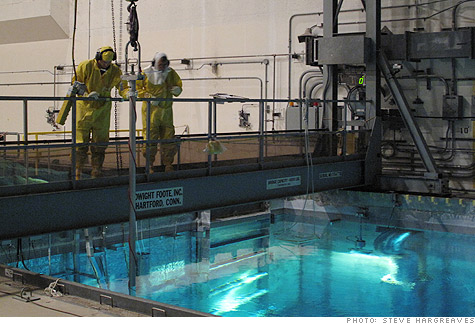
NEW YORK (CNNMoney) -- In the United States, 63,000 tons of nuclear waste, the sum total of all the waste generated by decades of nuclear power, sits right where it was created -- at the power plants themselves.

Often, these power plants are very close to major population centers -- Washington, Boston, New York City, Philadelphia and Chicago have reactors within the 50-mile fallout zone.


If the waste catches fire, a situation Japanese officials are racing to prevent at Japan's Fukushima Daiichi plant, critics say it could effectively render an area the size of half of New Jersey permanently uninhabitable.

"It's probably the single greatest security vulnerability in the United States," said Kevin Kamps, radioactive waste specialist at Beyond Nuclear, a watchdog group.
How close is your home to a nuclear power plant?

Kamps and many other industry critics want lawmakers to mandate that most of the waste, known as spent fuel, be stored away from the main reactors in certified steel and concrete casks, then have those casks placed in fortified buildings or earthen bunkers.

"But it's fallen on deaf ears in Congress," Kamps said.

Currently most of the waste sits close to the reactors in large pools that resemble swimming pools. A smaller amount is kept outside in casks that critics say are poorly guarded.

The reason so much waste is being stored at the nuclear power plants themselves is that the government hasn't figured out what to do with it permanently.

Storing the waste in this manner was supposed to be a temporary measure until it was permanently buried deep inside Nevada's Yucca mountain. But thanks to a mix of geology and politics, that site was recently deemed unsuitable.

The hunt is on for a new long term repository, but finding and building one will likely take decades.

The industry and the government say storing the waste at the power plants for decades isn't a problem.

"The fuel is safe, in a cask or in a pool," said David McIntyre, a spokesman for the government's Nuclear Regulatory Commission.

McIntyre said the government will take a look at waste storage as part of its comprehensive review following the events in Japan, but added that, at this time, "there's no safety reason to move it."

Industry critics couldn't disagree more.

They say the radioactive spent fuel rods, which rely on circulating water to remain cool, are vulnerable to both natural disaster or terrorist attack.

In a natural disaster, a power outage from an earthquake, hurricane, tornado or other event would cause the water pumps to fail. Yes, there are back up generators, but sometimes those fail too, as is the case in Japan. If that happens, it's only a mater of days until the fuel heats up to the point where it boils off the water and then catches fire.

They note that the pools themselves are located outside the reactor's main containment dome. An explosion, like what occurred in Japan, would expose the pools to the open air.

It's also possible for terrorists to specifically target the pools. Reactors like the ones in Japan, of which there are 23 in the United States, are particularly vulnerable. The pools in that design are located several stories above ground, making them easy targets for shoulder-fired missiles or airplane attacks.

Critics say the concrete and steel around the pools are designed to prevent radiation leaks, not to stop a missile.

"It's hard to understand why the Nuclear Regulatory Commission has not mandated a more rapid transfer of spent fuel to dry casks," California's Democrat senator, Dianne Feinstein, said at an appropriations subcommittee hearing Wednesday.

Kamps said the reason is cost -- that it would cost up to $100 million per reactor to move the fuel from the pools to reinforced dry cask storage, a cost the companies that run the plants do not want to bear.

The industry said cost has nothing to do with it.
0:00 /2:51Plant cleanup workers face hard task

"We're ready to cooperate with the NRC and others on all aspects of our operations," said Bryant Kinney, a spokesman for the Nuclear Energy Institute, an industry association.

Despite their willingness to cooperate on any additional safety measures the government may require, the industry feels the fuel is safe right were it is.

Kinney pointed to a 2002 study from the Electric Power Research Institute, an independent research organization, saying that the plants would withstand an impact from a commercial airliner. He said that includes the spent fuel pools.

Plus, moving the fuel from the pool to a cask is a dangerous operation in and of itself. There's no need to take that risk if, eventually, it will all be moved to permanent storage anyway.

The NRC said that since Sept 11, 2001, the industry has become much more prepared to deal with unexpected losses of power or attacks on its facilities. Preparations include pre-positioning generators, water and other equipment near a plant, but not close enough that they would be damaged in an attack or natural disaster.

As for the risks of a worst-case scenario, the NRC wouldn't speculate on just how large the contamination area might be, only to say that a fire in a spent fuel pool is "extremely unlikely."

Some experts have said the fallout zone would be smaller than a 50-mile radius. Others have said three times the size of New Jersey.

Everyone does agree on one thing: It would be a terrible situation

this from
http://money.cnn.com/2011/04/01/news/economy/nuclear_waste/index.htm

Report - Nasdaq and ICE make rival bid for NYSE


nyse_euronext.gi.top.jpg


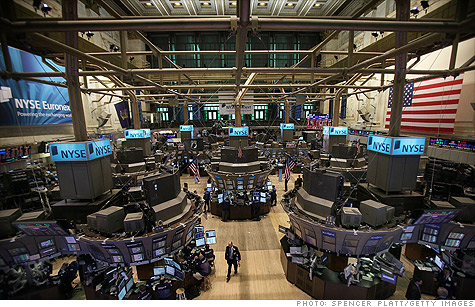
NEW YORK (CNNMoney) -- Nasdaq OMX and IntercontinentalExchange on Friday announced a joint $11.3 billion bid to buy the parent company of the New York Stock Exchange, topping an offer by Germany's Deutsche Boerse.

The rival bid comes after NYSE Euronext agreed in February to be bought by the German company for $10 billion in a deal that would create the world's largest exchange for stocks and derivatives.


Under the rival offer, NYSE Euronext (NYX, Fortune 500) stockholders would receive a mix of cash and shares of Nasdaq (NDAQ) and ICE (ICE) common stock, amounting to $42.50 for each NYSE Euronext share.

The offer represents a 19% premium over the one made by Deutsche Boerse, according to a statement from Nasdaq and ICE.

Shares of NYSE Euronext jumped nearly 12% to $39.33 in pre-market trading.

The two exchanges would spilt NYSE Euronext's businesses, with Atlanta-based ICE buying its derivatives business, according to the proposal.

Nasdaq would take over the stock exchanges, including the New York Stock Exchange and markets in Europe. In addition, Nasdaq would acquire NYSE Euronext's U.S. options business.

The combination would create "a leading international exchange" with operations in sixteen countries and technology that is used in over 60 markets internationally, according to Nasdaq.

The new exchange would be based in New York. ICE and Nasdaq would continue to operate as separate businesses if the deal is approved.

The development is part of what has been a wave of recent consolidation, as exchanges around the world look for ways to reduce transaction costs and increase exposure to the more lucrative derivatives, options and futures markets.

"Our industry is undergoing a period of historic change," said Nasdaq's chief executive, Robert Greifeld, in a statement.

While the Deutsche Boerse merger is expected to face heavy scrutiny from both U.S. and European regulators, the rival suitors believe they will be able to "satisfy the required regulatory approvals in all jurisdictions


this from
http://money.cnn.com/2011/04/01/news/companies/nyse_nasdaq_ice/index.htm