Business News Today

All News Business and Finance, banks and business companies and the economy you find here every day. Follow us in each new world of finance and business.

Calm stock and oddity jobs

الخميس، 31 مارس 2011


NEW YORK (CNNMoney) -- U.S. stocks quietly ended a turbulent, headline-filled first quarter on Thursday, with investors remaining in a holding pattern ahead of tomorrow's jobs report.

The Dow Jones industrial average (INDU) fell 31 points, or 0.2%. Intel (INTC, Fortune 500) shares were among the biggest decliners on the Dow, falling 1.4% after analysts at FBR Capital cut their price target on the chipmaker.


The S&P 500 (SPX) fell 2.4 points, or 0.2%; and Nasdaq Composite (COMP) rose 4 points, or less than 0.2%.

U.S. stocks posted solid gains this quarter, despite three months of geopolitical turmoil in the Middle East, the March earthquake and nuclear crisis in Japan, and lingering concerns about the U.S. economy. The Dow rose 6.5%, the S&P 500 up 5.6% and the Nasdaq up 4.8% in the first three months of the year.

"You've had a very resilient market in light of the headline news this quarter," said Quincy Krosby, market strategist with Prudential Financial. "But this market has been enjoying very loose monetary policy, which has helped offset the geopolitical concerns."

Fund managers and traders said they don't expect the second quarter to be a repeat performance of the last three months, especially with the lingering geopolitical uncertainty.

"If I had known these headlines were going to cross this past quarter, I would have cashed out of the market and hid under my bed," said Jack Ablin, chief market strategist for Harris Private Bank. "It's remarkable how well this market has held up."

It was a mostly quiet session on Thursday, with traders focusing on the jobs market. The Labor Department said weekly jobless claims fell to 388,000 in the week ended March 26, which was slightly higher than what economists expected.

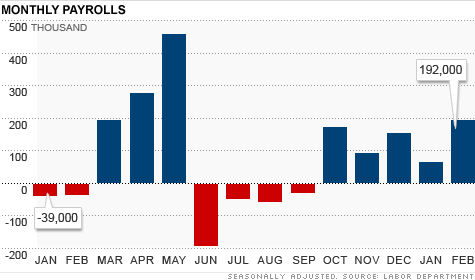
On Friday, the government will release the closely watched monthly jobs report. A CNNMoney survey of 18 economists forecasts a 180,000 jump in payrolls for March, with the unemployment rate holding steady at 8.9%.

Dick Del Bello, senior partner with hedge fund service provider Conifer Group, said investors are relatively optimistic about the job market, despite being frustrated with its slow recovery.

"I think the anticipation is that the job market is improving," he said. "It's slow, but it's improving. I think everyone would like to see it happen faster, but that's not going to happen."

U.S. stocks ended Wednesday with solid gains, after two upbeat reports on job growth.

Economy: The Chicago-area purchasing managers' index for March fell to a reading of 70.6, compared to February's reading of 71.2. Economists were looking for a reading of 68.9.

The Commerce Department said factory orders fell by 0.1% in February. Economists had expected a 0.4% rise.
0:00 /1:53Berkshire stock under pressure

Companies: Shares of Warren Buffett's Berkshire Hathaway (BRKA, Fortune 500) fell 2% , after Buffett's heir apparent, David Sokol, quit. In a press release Wednesday, Buffett said the resignation was a "total surprise," but he also revealed that Sokol had purchased shares of Lubrizol (LZ, Fortune 500) before pushing him to buy the company in March for $9.7 billion.

Shares of defense contractor Northrup Grumman (NOC, Fortune 500) fell 9% after analysts at Citigroup cut their price target for the company.

World markets: European markets closed broadly lower following the stress test results in Ireland. Britain's FTSE 100 fell 0.7%, the DAX in Germany fell 0.2%, while France's CAC 40 slipped 0.9%.

Asian markets ended mixed. The Shanghai Composite fell 0.9%, while the Hang Seng in Hong Kong ticked up 0.3% and Japan's Nikkei added nearly 0.5%.

Treasury Secretary Tim Geithner, in China for a meeting of G-20 finance ministers, said developing nations need flexible exchange rates to help absorb economic shocks. His comments came a day after criticism of U.S. monetary policy by a Chinese economist.

Currencies and commodities: The dollar fell against the euro and the Japanese yen, but was flat versus the British pound.

Oil for May delivery gained $2.36 to $106.63 a barrel.

Gold futures for June delivery rose $15.10 to $1,438.90 an ounce.

Bonds: The price on the benchmark 10-year U.S. Treasury rose slightly, pushing the yield down to 3.43% from 3.45% late Wednesday

New monopolies Google


NEW YORK (CNNMoney) -- Microsoft has a surprising ally in its argument that Google is an abusive monopolist: Samuel Miller, the prosecutor who led the federal government's first antitrust case against Microsoft more than a decade ago.

"Having prosecuted the Microsoft case, its seems to me that Google, as a monopoly, is engaging in the same tactics to keep its dominant position as Microsoft was engaging in," Miller says. "Those are the same tactics that got Microsoft in trouble."

    * 9
    *
    *

    * Email
    * Print

Miller served as the lead counsel in the inaugural United States v. Microsoft case, which the Department of Justice brought in the early '90s. It was the first in a series of landmark legal skirmishes that finally ended in 2001 with a consent decree constraining Microsoft's business practices.

In that case and in a similar trial in the European Union, Microsoft was found to have violated antitrust laws.

In a juicy, ironic twist of fate, Microsoft (MSFT, Fortune 500) now finds itself on the opposite side of the battle. It claims that rival Google (GOOG, Fortune 500) is unfairly using its position as a monopoly in the search market to impede the software giant's ability to compete. Microsoft filed a formal complaint with the European Commission on Thursday.

In a blog post enumerating the company's grievances, Microsoft chief counsel Brad Smith cited several examples of what his company claims are Google's unfair business practices.

Miller believes all of Microsoft's arguments are "valid and worthy of serious consideration."

Other antitrust attorneys, professors and experts had differing views.

Abusing ownership of YouTube: Most agreed that of all Microsoft's arguments against Google, the most damning would be the claim that Google uses its ownership of YouTube to disadvantage competitors' search results.

Microsoft says that Google has put in place technical measures that restrict Microsoft's Bing search engine, as well as other search rivals, from "properly accessing" YouTube for their search results. It claims Google uses that otherwise restricted data to index YouTube videos in its own search results.

As a result, Google's search results for YouTube videos are better than its competitors', Microsoft says.

That's a no-no, experts say.

"The most egregious claim is that Google has access to interconnectivity with YouTube and manipulates that vertically integrated property to its own advantage," said Michael Hausfeld, founder of antitrust firm Hausfeld LLP and former lead counsel in the United States' antitrust case against Intel (INTC, Fortune 500). "Microsoft, as a competitor, requires equal access."
0:00 /3:47Mozilla CEO: Google isn't 'open'

In response, Google didn't confirm or deny Microsoft's claim. But the company notes that the results of a YouTube video search on Bing look, to a layman, much the same as Google's search results. But experts struck that down as a non-legal argument.

"What Microsoft is saying is Google is putting in place technical roadblocks to YouTube," Miller said. "If Google didn't have a dominant position, it wouldn't be an issue."

Hoarding AdWords data: Another of Microsoft's claims is that Google is breaking antitrust rules because its ad platform data lacks interoperability with Microsoft's.

That charge drew a much more skeptical response from experts.

Both companies compete in the online advertising market, and Microsoft says that Google prevents advertisers from easily porting their ad campaign data to competing platforms, such as Microsoft's adCenter.

It's not a simple process, but it's hardly an impossible one. Microsoft even explains on its own website how data from Google's AdWords can be exported from Google and imported to adCenter.

"Microsoft's claim is belied by a number of third party platforms that support multiple ad platforms," Andrew Frank, an analyst at Gartner, pointed out.

Frank also noted that Microsoft's argument that "this data belongs to the advertisers" is dubious, since advertisers enter into standard legal agreements signing that data over to Google.

From a legal standpoint, one expert said this is Microsoft's least convincing argument.

"If Microsoft is complaining that the information received from Google doesn't work as well with Microsoft's systems as with Google's, that should be Microsoft's responsibility to improve its own product," Hausfeld said.

But in this case, Microsoft may have a point, Miller thinks: The European Commission, which interprets "exclusionary acts" much more loosely than the United States, ruled in Microsoft's antitrust case that Microsoft had to add interoperability to its software to enhance competition.

Exclusivity: Microsoft claims that Google undermines its competition by entering into exclusive agreements with websites to power the search boxes on their sites. The company has locked up so much real estate on European's leading websites that rivals can't get a foot in the door, it says.

That argument seems suspicious on the surface, since Microsoft engages in the same behavior. For example, Microsoft has a high-profile search exclusivity agreement with Facebook.

Hausfeld thinks that the European Commission might simply encourage both companies to end their exclusivity agreements, without ruling one way or the other.

But Miller disagreed. He sees a clear difference between Google's exclusivity deals and Microsoft's: Google's are coming from a firm that already has a 90% market share in Europe.

"Google is creating a web of contractual arrangements -- carrots and sticks -- that make it hard for Google's customers to deal with rivals like Microsoft Bing," he said.

Good jobs news is good news. Capisce?


And when it comes to the crucial monthly employment numbers from the government, many traders worry more about how the jobs data will influence the Federal Reserve's monetary policy than what it means for the average guy or gal trying to find work.

Look what happened on Wednesday. Payroll processor ADP (ADP, Fortune 500) announced that 201,000 jobs were added in the private sector in March. That's good but not great. And it was also slightly below forecasts.

But stocks rose Wednesday -- partly due to the notion that these numbers give the Fed a Goldilocks scenario where it can justify keeping rates low for a lot longer.

Simply put, that's dumb. The economy -- and stock market -- would be much better off if jobs growth really starts to pick up in a much more significant way.

If the government says that more than 250,000 jobs were added in March -- the consensus estimate of economists surveyed by CNNMoney is for an increase of 180,000 -- then that's a cause for celebration, not concern.

Barry Ritholtz, CEO of Fusion IQ, a New York-based research firm, said that some investors, particularly in the fixed-income market, may worry that a strong jobs number will mean the Fed is less likely to launch another round of bond buying after the so-called QE2 plan ends in June.

But Ritholtz referred to those who take that view as "bond ghouls" who are more worried about "what's good for the trading book and not the country."

"Bad news is bad and good news is good. If the jobs number disappoints, people shouldn't cheer that there will be another round of QE," he said. "A good jobs number is good for consumer spending and profits."
Factories have trouble finding workers

You'd like to think most investors would realize this is true. More people working equals more people spending and a stronger, healthier economy. The goals of Wall Street and Main Street don't have to contradict each other.

Unfortunately though, many investors are myopically too focused on the short-term ups and downs of stocks and bonds to take a longer-term view.

Some people worry that the only reason the market (and to a certain extent, the economy) has held up as well as it has for the past few months is because of the Fed's easy money policies.

That's why it's a bit of a mystery how investors will interpret the March jobs numbers. There is one camp who thinks a robust job number would be a negative because it could lead to no more quantitative easing from the Fed.

But another group (including even Fed members such as Dallas Fed president Richard Fisher and St. Louis Fed president James Bullard) believes that the central bank has to be more worried about inflation.
0:00 /3:55Want jobs? Fix the patent system

Their argument is that the Fed should not only end any debate about more bond buying; it also should consider raising interest rates sooner rather than later.

"What's really puzzling is that there are two diverging opinions," said Dan Cook, CEO of IG Markets, a brokerage firm in Chicago. "Some people are whispering about the need for QE3 but others are saying the Fed has to scale back QE2 before it's over."

Cook said that even if the jobs number is better than forecasts, it's unlikely to be so strong that it would lead the Fed to do something drastic in the next few months.

Yes, the unemployment rate has dropped sharply. But even if it falls a bit from February's 8.9% level, it would still be relatively high by historical standards.

"It's really is hard to say the job market right now is good," Cook said.
Return of the headhunters

So investors should not go nuts and speculate about what the Fed might do solely on the jobs number.

The Fed looks more at longer-term trends as opposed to individual monthly reports. And there's also other parts of the economy that are so weak that the Fed and investors can't ignore. Housing market, anyone?

"It's silly to worry about jobs being too good," said Rex Macey, chief investment officer Wilmington Trust Investment Management in Atlanta. "It's one number and given all the revisions that often happen and other economic reports, it's crazy to think that one monthly number will change Fed policy."

Finally, investors that want to see QE3 (and perhaps QE4 and QE5) may need to face facts and realize that the market can't remain addicted to low rates forever.

If the economy is really improving, the Fed has to raise rates. That's not the end of the world.

"Let's face it. The Fed is going to tighten someday," said Macey.

-- The opinions expressed in this commentary are solely those of Paul R. La Monica. Other than Time Warner, the parent of CNNMoney, and Abbott Laboratories, La Monica does not own positions in any individual stocks.